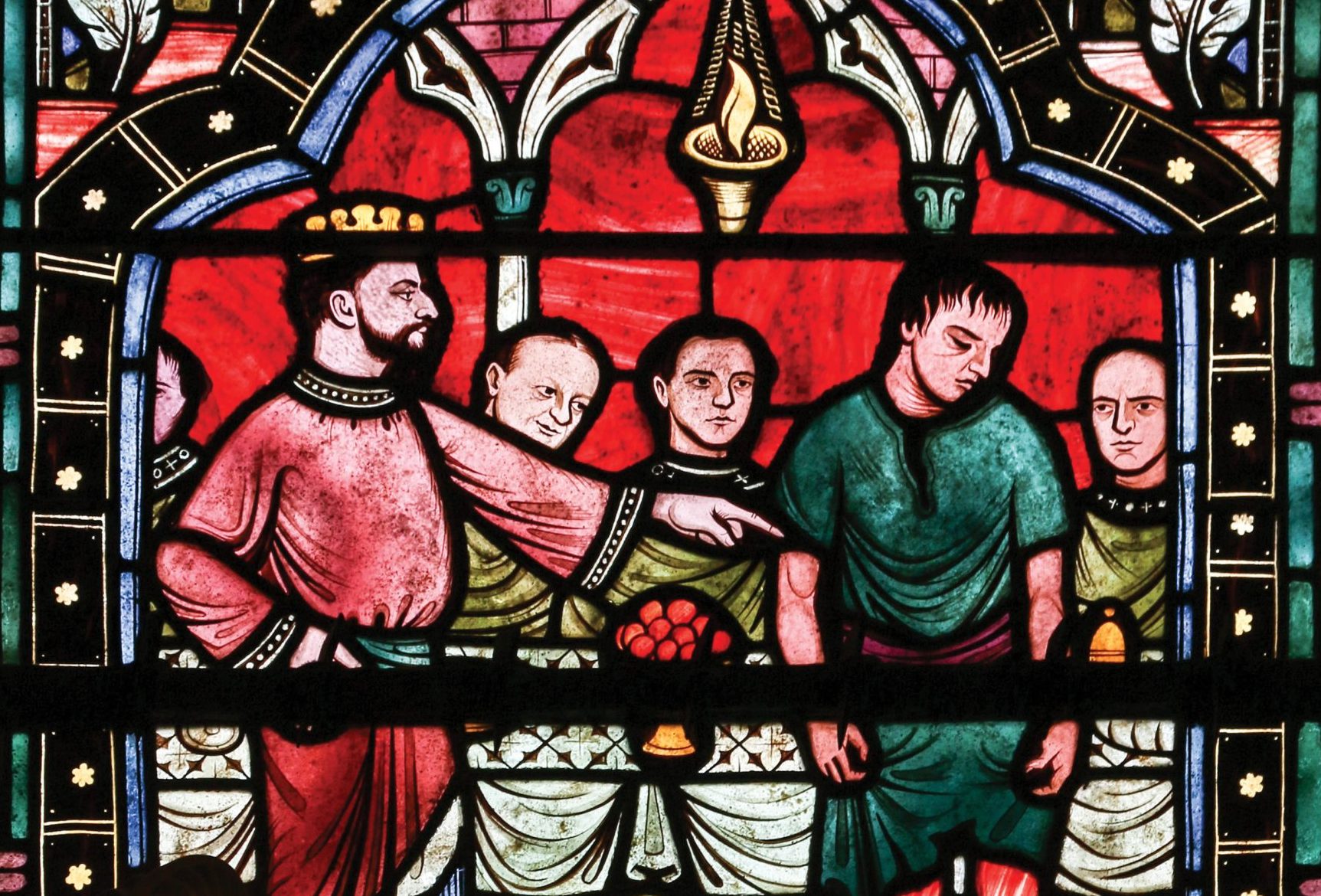
The pairing of the Gospel reading for this Sunday with the passage from Isaiah about the feast to be provided by God naturally leads us to think of the king in Matthew’s parable as representing God. A commentary by Tobias Winright on the Catholic Moral Theology site cites one source that makes the alignment explicit:
the author of Matthew’s Gospel “intends this to be read as an allegory, and his first readers would know how to decode the details”: king=God; son=Jesus; marriage feast=the great wedding banquet at the end of the age; slaves=prophets; those invited=Israel; violence=Israel’s rejection of the prophets; destroyed city=fall of Jerusalem in 70 CE; gathering of good and bad=the evangelistic mission of the church; wedding hall=church
That interpretation seems obvious but what should we make of the man not wearing a wedding robe? At times in the past I have been told that the appropriate garments were provided by the host, leaving no real excuse for failing to dress appropriately. Commentary by Allison Holst-Grubbe on the U.S. Catholic site makes that point and goes on to suggest that “accepting the invitation means allowing God’s grace to change us. The wedding garment represents transformation. But we do have to put it on.” Failure to accept transformation by God’s grace results in ejection from the feast. Winright offers essentially the same explanation as does Robin Gibbons on the Independent Catholic News site.
In another piece on the U. S. Catholic site, What if God isn’t the king in the parable of the wedding feast?, Emily Sanna offers a very different interpretation. She notes that the common interpretation of the parable presents God as a despot who imposes unreasonable punishment but that this interpretation does not match what we learn of Jesus elsewhere in the Gospel of Matthew. Her alternative interpretation is to see the king, not as God, but as a human king abusing his power. She suggests that the king’s hospitality is not genuine, but performative:
He invites outsiders in, but he does not relinquish power. He decides who comes, what they wear, and how they participate. The guests are not welcomed but are part of his show. Maybe the man doesn’t wear the wrong clothes because he’s unaware of the dress code or unprepared to be in the king’s presence, but because he refuses to accept state violence.
She goes on to note that Matthew’s gospel has other examples, from the Magi on, of people quietly resisting state power as Jesus did. In this reading, the message is not about arriving at God’s table properly prepared but about mistaking empire for God’s table.
To accept systems that depend on someone else’s suffering, to consume more without considering the effects of our consumption, to confuse physical wealth or comfort with God’s blessing. The man willing to be thrown into the outer darkness rather than participate in empire’s sham is a reminder that following Christ sometimes means rejecting what society tells us to do.
The weight of numbers is with the conventional interpretation but the caution against complicity in oppressive political and economic systems is a point well made and a plausible alternative if we accept that the Church should exhibit a preferential option for the poor.
Leave a Reply